


Climate protection and energy management
Our goal
In order to maximize environmental and climate protection as an educational institution, Coburg University of Applied Sciences relies on a diversified strategy. The first milestone of this strategy, Coburg University of Applied Sciences’ climate protection concept, has already been reached. It sets out 49 measures aimed at achieving greenhouse gas neutrality at our university by 2040. Another part of the approach is the introduction of an energy management system (EnMS) in accordance with DIN ISO 50001 and DIN ISO 50005.
Climate protection concept
Our university has developed and is implementing a comprehensive climate protection concept that serves as a strategic basis for future climate protection measures. It defines clear responsibilities in university policy and administration and actively involves students, employees and external stakeholders. Our concept analyzes technical and economic measures to reduce emissions and sets specific short-term (up to 3 years), medium-term (3-7 years) and long-term (over 7 years) targets. In this way, we make a significant contribution to climate protection and position ourselves as a pioneer in this area.
Current projects:
- Integrated KSK of the HSCO for 2023 (DOWNLOAD LANGVERSION)
- Integrated KSK of the HSCO for 2023 (DOWNLOAD SHORT VERSION)
- CLIMATE PROTECTION 2024 COMPACT (DOWNLOAD AVAILABLE SOON)
- CLIMATE PROTECTION 2025 COMPACT (DOWNLOAD AVAILABLE SOON)
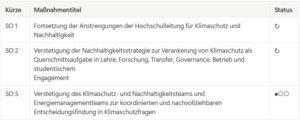
Measures completed or in the process of implementation
Waste and (waste) water

Procurement
No measures implemented or in the process of implementation
Energy
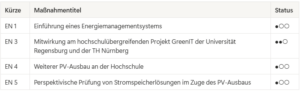
Mobility

Climate impact adaptation

Other
Energy management system (EnMS)
In order to make environmental and climate protection goals visible, our university will initialize an EnMS according to DIN ISO 50001 and DIN ISO 50005 by 2027. It is intended to show how much energy our university consumes and what continuous and everyday possibilities it has to reduce this consumption. It thus serves as the basis for a continuous reduction in energy consumption and makes a significant contribution to environmental and climate protection. The EnMS also makes a significant contribution to fulfilling various legal requirements (e.g. Section 6 (1, 2, 4) EnEfG).
Current work status:
✓ Management commitment and objectives
✓ Creation of an EnMS team and appointment of an energy manager
✓ Analysis of actual energy consumption
→ Define energy policy and strategy
→ Set up data collection and monitoring
→ Identification of potential savings
→ Implement measures to increase efficiency
→ Training and awareness-raising
→ Regular review and auditing
→ Continuous optimization (CIP)
Project participants
- Dr. Matthias J. Kaiser, Chancellor of Coburg University of Applied Sciences
- Prof. Dr. Felix Weispfenning, Vice President of the Coburg University of Applied Sciences
- Rafael Vogt, climate protection and energy manager
- Susanna Buchwald, Head of Technology and Construction Department
- Sandro Krempel, Head of Technology and Construction Department
- Sebastian Bieber, employee in the Technology and Construction department
- Stefan Schwuchow, employee in the Sustainability department
Together with further scientific support:
- Prof. Dr. Matthäus Brela, Lecturer at the Faculty of Electrical Engineering and Computer Science
- Prof. Dr. Matthias Mörz, Lecturer at the Faculty of Electrical Engineering and Computer Science
- Prof. Dr. Bernd Hüttl, Lecturer at the Faculty of Electrical Engineering and Computer Science
- Prof. Dr. Michael Schaub, Lecturer at the Faculty of Design
Why EVERYONE must lead the fight against the looming climate catastrophe
The urgency with which we must dedicate ourselves to the fight against climate catastrophe cannot be overstated. Since the signing of the Paris Climate Agreement in December 2015, which set the goal of limiting global warming to below 2.0 °C, the situation has only worsened. Current forecasts show that we are on a direct path to achieving a warming of at least 2.7 °C compared to the pre-industrial age. To halt this process, we need to multiply our efforts.
CO₂ levels in the atmosphere have risen dramatically since the beginning of the industrial revolution. While CO₂ fluctuations in the atmosphere once followed natural, consistent patterns, human influence has profoundly disrupted this cycle. The exponential rise in CO₂ levels, driven by the burning of fossil fuels, deforestation and other industrial processes, has led us into an era of uncertainty and impending catastrophe.
Carbon dioxide, as one of the main greenhouse gases, plays a central role in the rise in temperature of our planet. The consequences of this warming have been known for some time. What is relatively new is that we are contributing to exceeding climate tipping points by reaching ever new average temperature records. According to current knowledge and technology, these climate tipping points are not reversible. On the contrary, once such a tipping point has been reached, it can serve as a catalyst. For example, the thawing of permafrost soils causes the release of the highly potent greenhouse gas methane (CH₄). This gas accelerates the effect of global warming many times over.
The urgency with which we need to take action to reduce CO₂ emissions, accelerate the transition to renewable energy and promote sustainable lifestyles has never been greater. The climate crisis does not wait for our convenience or political decision-making processes. Every day we procrastinate brings us closer to a point where the effects of climate change become irreversible.
Contact us
Climate protection manager