


Steps to Take Before Starting College
Let's get started
You have successfully enrolled at Coburg University of Applied Sciences and Arts. You are now officially a student here. Here you’ll find all the dates for the start of the academic year.
These steps are important for getting off to a successful start with us:
1. Activate your user account
As a student at the Coburg University of Applied Sciences and Arts, you have your own user account. The account has already been created for you and must be activated by you before you begin your studies. You can activate your user account only after you have enrolled.
You’ll need your user account for:
- Access to our student portal, my campus, with links to all of the university’s online services (Primuss, Moodle, email)
- Access to Your Email Account
- Logging In to the “HS-Coburg” Wi-Fi Network
- Use of Computer Workstations at the University
- Using the FollowMe Central Printing System
- Access to the university servers (from inside and outside the campus)
2. Instructions for Activating Your User Account
One day after you have successfully enrolled at Coburg University of Applied Sciences and Arts, you can activate your user account. To do so, follow these steps:
- To activate your user account, you’ll need your student ID number. You can find it on your admission letter.
- The university’s services are directly accessible only within Europe.
To access the services from outside Europe, please use a VPN. If you have any questions, please contact the IT-Service@hs-coburg.de. - Follow the link https://www.hs-coburg.de/activation and enter your information there (as described above, students need their student ID number, while employees need an activation code)
- You will then receive your username and your university email address. Using your username and the password you set, you can now log in to your student account and access the university’s many IT services.
- Please also note the instructions for secure login using multi-factor authentication.
3. mycampus - our student portal
Once your user account has been activated, you’ll have access to our student portal, mycampus. The mycampus student portal is the central platform for your studies at the Coburg University of Applied Sciences and Arts.
On mycampus, you’ll find:
- Announcements and News from Your Degree Program
- Program-specific documents and forms (module handbooks, class and exam schedules, internships, etc.)
- Special Services for Students
- Latest News from Coburg University of Applied Sciences and Arts
- Upcoming Events of Interest
Once you’re logged in to mycampus, you’ll have direct access to the following via the “My Services” menu item:
- PRIMUSS
- Moodle
- your university email inbox, and much more
We’ve summarized here what each online service has to offer and how you can find our services on mycampus.
Tutorial - A Brief Overview of All Features in mycampus
You are currently viewing a placeholder content from YouTube. To access the actual content, click the button below. Please note that doing so will share data with third-party providers.
More InformationOther Platforms—Essential for Your Studies
PRIMUSS
The PRIMUSS portal includes all the features you need to organize your studies.
With PRIMUSS, you can:
- View and print your enrollment certificate
- Register for elective courses in your degree program
- Register for Exams
- View your exam results and grades , and generate a transcript
- Register for the next semester
- Enter address changes
- Register for college sports classes
- and much more
Moodle
The Moodle learning platform gives you access to course materials from lectures, seminars, and exercises. It’s also an ideal platform for conducting group work digitally.
During your program-specific orientation at the start of the semester, you’ll receive an introduction to using Moodle. A brief digital introduction is also available on Moodle itself.
If you have any questions about specific course access (registration codes) or about specific course content, please contact the instructor responsible for the course in question.
You can also find the link to Moodle under “My Services” in mycampus.
Once your student account has been activated, a university email account with your personal email address will be automatically set up for you. Your email address is usually structured as follows: vorname.nachname@stud.coburg-university.de.
You can access your emails through the university’s Outlook Web Access https://outlook.office.com .
Note: Your login name is “Your username@hs-coburg.de” (not your email address).
You can find more information on our student portal, my campus.
Please check your email regularly. You’ll receive push notifications as soon as new information about your studies is posted on mycampus.
Microsoft Teams
To make it easier for you to communicate with your fellow students, Microsoft Teams is available to you.
The most important features are:
- Sending and Receiving Confidential Messages
- Direct messages from person to person
- Topic-Based Closed Groups
- Fast File Sharing
- Audio/video chats in groups or with individual people (including external participants)
- An Alternative to Using Private Messaging Apps
Login: https://teams.microsoft.com ( Your username is “Your Nutzername@hs-coburg.de“)
For more information, visit the IT Services website and our student portal, mycampus.
Service Facilities

Throughout your studies, Coburg University of Applied Sciences and Arts will support you with a variety of services. You can find a complete overview of our individual service departments here.
The specific services offered by our service centers can be found on our student portal, mycampus, under the “Service” section. You can subscribe directly to updates from the service centers so you don’t miss any current offers or events.
Student ID Card
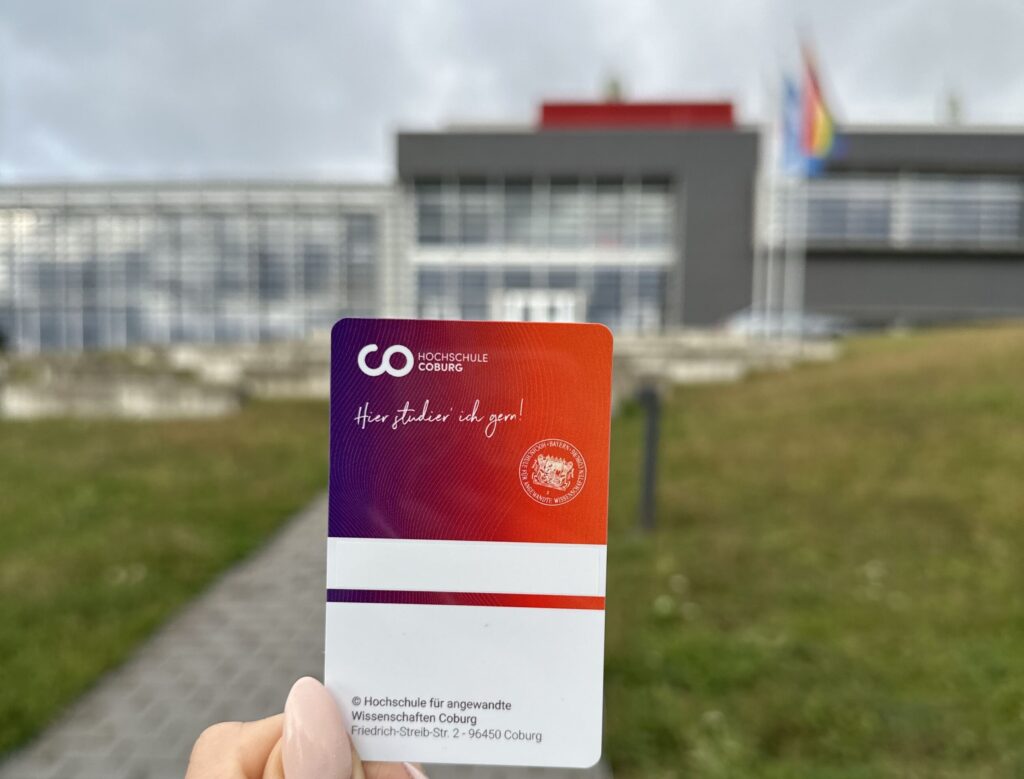
The student ID card is a multifunctional card with a built-in payment chip. It serves as proof that you are a student and is valid as a semester pass for buses and trains, serves as a library card, and can be used to pay at the dining hall, cafeteria, coffee machines, and the university’s printers.
All the important information on how and when you'll receive your student ID:
Shipping within Germany
If the address you provided in your application is in Germany, the Office of Student Affairs will automatically mail your student ID card to you.
Pickup for Students Living Abroad
If your address is outside of Germany, you can pick up your student ID in person at the university.
Change of Address
The ID card will be mailed to the address you provided in your application.
If your address has changed, please let us know immediately. You can update your address in the PRIMUSS portal under “Applications” as soon as your student user account has been activated.
Validity
Student ID cards for first-semester students have already been validated (activated) and are valid starting at the beginning of the semester.
If you have any questions about the mailing of student ID cards, please contact the Office of Academic Affairs: studienangelegenheiten@hs-coburg.de.
Semester Pass
Students studying in Coburg can use their student ID card as a ticket on certain public transportation routes. The semester ticket is negotiated and offered by the Student Council in collaboration with the Oberfranken Student Services Organization. The Semester ticket is included in the semester fee.
As a student at the Coburg University of Applied Sciences and Arts, you can also purchase a discounted Deutschland-Ticket. You can find more information here.
What you should also do
Print Enrollment Certificate
You’ll need the certificate of enrollment, for example, as proof when applying for child support or enrolling in health insurance. You can print this out yourself as soon as you’ve activated your student account with us. Log in to the PRIMUSS portal using your login credentials (username and password). There, under the “Certificates” section, you’ll find the certificate of enrollment.
Activate Wi-Fi
Coburg University of Applied Sciences and Arts has its own campus Wi-Fi network. The Wi-Fi network name is “HS-Coburg.” To log in, enter your username and password. The password is the same as the one you use for your user account. In addition to the university Wi-Fi, you can also use “Eduroam.” For more information about these Wi-Fi networks and how to set them up, visit the “Wi-Fi/VPN” page of IT Services on mycampus.
Having technical problems? Our IT support team is here to help
Our IT Service is your first point of contact for any questions or problems related to the university’s IT services, and we’re here to help you with:
- Configuring university IT services on personal computers and mobile devices
- Setting up the Wi-Fi (eduroam)
- the printing system (FollowMe)
- and much more.
This service is free for students. In addition, the university provides software that you can use on your personal computer at a discounted rate or even for free during your studies. Further information, instructions for software installation, and access to online services are available on the IT Service page of the mycampus student portal or directly from the IT Service.
Terms Related to College
What are ECTS? What does the abbreviation SWS stand for? What is a semester? To start with, we recommend that you familiarize yourself with the most important terms related to your studies.
Bachelor's and Master's Degrees
Degrees at universities are structured in a tiered system: The bachelor’s degree is the first academic degree. It is intended to prepare students for the workforce. University graduates with a bachelor’s degree can immediately pursue a master’s program (consecutive master’s). Alternatively, they can first gain practical experience and then begin a Master’s program—usually while working—that draws more heavily on the knowledge gained from their job (professional Master’s). The Bachelor’s/Master’s system replaces the former German “Diplom” program. The transition to Bachelor’s and Master’s degrees is intended to ensure that academic degrees are internationally comparable.
ECTS
To help students estimate the workload for individual modules, the various modules are assigned so-called ECTS credits. ECTS stands for European Credit Transfer and Accumulation System. All European universities use this system. The goal is to make the workload for degree programs in Europe comparable. Over the course of a seven-semester degree program, each student earns a total of 210 ECTS. ECTS or credit points are not grades. They simply indicate how many modules a student has already completed.
Student Council and Student Parliament
The term “Fachschaft” refers to the student council (SV) within a faculty. The Student Parliament brings together student representatives from across the entire university. Both the Fachschaft and the Student Parliament are directly elected by students in university elections.
Faculty
A faculty brings together several degree programs and research institutions within a specific field of study. It is headed by a dean. At Coburg University of Applied Sciences and Arts, for example, there is the “Applied Natural Sciences and Health” faculty, which offers bachelor’s degree programs such as Integrative Health Promotion and Bioanalytics, and the “Design” faculty, which combines the bachelor’s degree programs in Architecture, Interior Architecture, Integrated Product Design, and Civil Engineering.
Fellow students and faculty members
The term “fellow students” refers to the other students enrolled at the university. “Faculty” is a collective term for all instructors at universities.
Mentors / Mentoring
Unlike a tutor, who is responsible for specific subject matter, a mentor is someone who serves as a personal point of contact, offering support and drawing on his or her own experiences to help you.
Module
A degree program is divided into several modules, each of which consists of coordinated courses (lectures, exercises, lab sessions, seminars) that cover a specific subject area. A distinction is made between required modules, which must be taken in all cases, and required-elective modules, in which students can choose from a range of specified options. There are also elective modules. Here, the choice is very flexible, and students can often even select courses from other disciplines. Modules are generally graded and assigned a fixed number of ECTS credits. A description of the modules in a degree program can be found in the respective module handbook, which is also available online on the program’s web pages.
Standard Duration of Study
The standard period of study specifies the ideal timeframe within which students should complete their degree. It is set for each individual degree program and is generally seven semesters for bachelor’s programs at Coburg University of Applied Sciences and Arts. (Exceptions: Architecture and Interior Design, which are eight semesters.) The duration of BAföG funding is usually tied to the standard period of study.
Semester
The academic program is organized into semesters (= half a year). At Bavarian universities, the winter semester runs from October 1 to March 14, and the summer semester from March 15 to September 30.
The term “university semester” refers to all semesters during which a student is enrolled at a German university, regardless of the degree program. This means that even after changing majors or universities, the number of university semesters continues to increase. In contrast, program semesters are the semesters during which students are enrolled in a specific degree program. If a student changes degree programs, the number of program semesters starts at zero. Some universities also use the terms “study semester” or “exam semester.” These refer to the student’s academic progress based on the respective study and examination regulations. During a leave of absence semester, the student retains their student status, but exam requirements are suspended. Semesters of leave are granted, for example, in cases of illness, parental leave, or caring for family members. A semester of leave must be applied for in a timely manner via the PRIMUSS portal. Questions regarding semesters of leave are answered by the university’s Office of Academic Affairs.
Tuition
Coburg University of Applied Sciences and Arts is legally required to collect the so-called semester fee from its students. The university then transfers this fee to the Oberfranken Student Services Organization.
SPO
The Study and Examination Regulations (SPO for short) contain guidelines and rules regarding the structure of the program, its content, and its objectives. They also specify which modules must be successfully completed to earn the desired degree and how the grades from these exams are weighted toward the final grade. In addition, deadlines for taking exams for the first time and requirements for advancing to the next semester may be specified. This means that students may only advance to a higher semester if they have successfully passed certain modules. Students who simply let exam deadlines pass will receive a so-called “deadline failure,” and the exam is considered failed. Exams cannot be retaken an unlimited number of times, and there are restrictions, for example, on the number of third-attempt exams. Students should be familiar with their respective SPO.
SWS
SWS stands for “Semester-Week-Hours.” One SWS lasts 45 minutes—the same length as a school period. If a course has two SWS per semester, that means you attend that course for 1.5 hours per week.
Tutors / Tutorial
A tutorial is always a voluntary session led not by a professor, but by a student from a higher semester, known as a tutor. In a tutorial, the content of a lecture is discussed and practiced. At Coburg University of Applied Sciences and Arts, there are subject-specific tutorials (tutorials for specific required courses in the respective degree programs).
Types of Events
A lecture is a course in which a professor imparts knowledge to a large number of students, usually in a traditional lecture format. In a seminar, students apply the knowledge gained in lectures. For example, they work through exercise sheets or discuss open-ended questions. A tutorial therefore always involves a smaller group size. In a seminar ( seminar-style instruction), course content is explored in smaller groups. Knowledge is not merely imparted by instructors but is developed collaboratively with the students. In an internship, the focus is on applying theoretical knowledge in a practical setting. Internships are divided into two categories: internal internships in the university’s own laboratories and internships at external companies or organizations, where students gain insight into their future work environment. Many degree programs at Coburg University of Applied Sciences and Arts include a mandatory internship semester in the 4th or 5th semester.