


2025 Scholarship Recipients
Tomorrow’s Female Entrepreneurs
foundHER supports women on their path to self-employment and strengthens their entrepreneurial skills. The current scholarship recipients are distinguished by their creativity, dedication, and courage, and are turning their startup ideas into reality. With their diverse backgrounds, experiences, and visions, they contribute to an inspiring network of female founders who support and motivate one another.
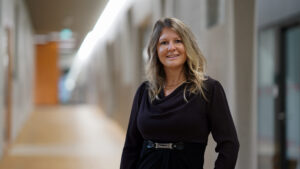
Christin Fichtmüller
Explain your idea in a few sentences!
The app-based online parenting program offers preventive and therapeutic support that is available anytime, anywhere, providing early and low-threshold access to an online program. It makes it possible to increase the number of participants. Parents can get started right away, and everything can be done online. Follow-up care is integrated. My app combines the application process, the program itself, and follow-up care.
How did you come up with your business idea? What problem are you solving?
The idea for the Eltern-Kur app arose from the desire to better support parents during stressful life phases—early on, in a straightforward way, and with lasting results.
Many parents find applying for a health retreat to be a challenge: uncertainties about the process, long wait times, and a lack of transparency often result in urgently needed help arriving too late. This can have physical, mental, and emotional consequences—not only for the parents, but for the entire family.
That’s exactly where my app comes in: It provides digital access that simplifies the entire process—from submitting an application to organizing the event and providing follow-up support.
Online access makes it easier to find information, make decisions, and get your bearings regardless of time or place.
Follow-up care is particularly important to me, because the real challenge often begins after the treatment program: How can we successfully integrate what we’ve learned and experienced into our daily lives?
This is exactly where the app aims to support parents—so that relief isn’t just a fleeting moment, but has a lasting effect.
How far have you been able to take your idea this year, and where are you at right now?
This year was a real milestone for my Eltern-Kur app—what started as an initial idea has turned into a tangible concept.
I was able not only to refine my vision but also to expand it significantly. Through many conversations with affected parents, I gained valuable insights that were directly incorporated into the app’s further development. I’m currently working intensively on the first prototype, which truly reflects the needs of families—from registration to follow-up care.
The next big step is to engage in discussions with health insurance providers to position the app as a supportive resource, tailor it to their needs, and make it accessible to as many parents as possible. I’m convinced this app can make a real difference—and I’m ready to continue on this path.
What was your experience like while participating in foundHER?
To me, foundHER is like a “compass on the startup journey.”
I received an incredible number of valuable tips that helped me refine and further develop my idea for the Eltern-Kur app.
The various workshops and the exchange with other female founders were particularly enriching—this network not only opened up new perspectives for me but also gave me courage.
Thank you for the inspiration, the support, and the space to think big.
How has your idea—or you yourself—changed over the course of the program?
Over the course of the program, my vision for the Online Eltern-Kur app has evolved significantly.
What began as a rough draft is now a well-developed concept that provides holistic support for parents—from registration through early enrollment to follow-up care.
I’ve learned to communicate more clearly, think more boldly, and trust my intuition.
This app isn’t just meant to simplify processes—it’s meant to strengthen families.
What tips or advice would you like to share with other women who are thinking about starting a business?
If you feel an idea taking shape inside you—go for it! Give it a try, because great things often start with a small moment of courage!
Starting a business doesn’t mean knowing everything. It means having the courage to take the first step—even if the path isn’t entirely clear yet.
You’ll grow, you’ll stumble, but don’t give up! Surround yourself with people who encourage you. Seek out support. And above all: Trust yourself.
Because your vision deserves to be seen.
You don’t have to be perfect. You just have to get started.
Christin Fichtmüller was accompanied by Maria Simmler.
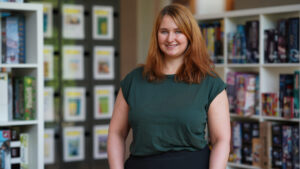
Melanie Fraas
Explain your idea in a few sentences! How did you come up with your business idea? What problem are you solving?
I’m developing an app designed to support neurodivergent adults in their daily lives. My focus is primarily on people with ADHD, since I was diagnosed with ADHD myself earlier this year and therefore know from personal experience how often you simply struggle with everyday life, forget important things, and—among other things—have trouble focusing and staying organized. This is exactly where the app is meant to help users gain better control over their lives. But it’s not just about organization—the app is also meant to be a kind of life coach that provides support and motivation during difficult moments. It is by no means intended to be a substitute for medical and psychological care, but rather a supplement, since the waiting lists for diagnosis and treatment are, unfortunately, very, very long.
How far have you been able to take your idea this year, and where are you at right now?
Right now, I’m in the process of defining the app’s scope of features. What should it be able to do? What can be implemented easily, and what should be developed in the future? The next step will be to develop a prototype. I’ll also soon have my own office space at Zukunft.Coburg.Digital is on the horizon, and the date for the official launch is in sight—that’s already more than I ever dreamed of. I’ve also had some great successes in other areas, like participating in Pitch & Beer this summer and winning the pitch event at the Upper Franconia Innovation Summit (UFIS).
What was your experience like while participating in foundHER?
This year, I’ve explored key aspects of starting a business and learned a great deal—for example, how to develop a business model. The workshops and insights we get at foundHER are truly invaluable. I’ve also been able to make an incredible number of connections within the local startup scene—it’s just a completely different mindset than anything I’ve experienced so far in my professional career. Connecting with the other women at foundHER has also been especially rewarding. We regularly share ideas and support each other whenever we can. It’s great to see the progress the others are making. And sometimes it’s also reassuring to see that it’s completely normal to struggle and have doubts at certain points in the process. We all go through that.
How has your idea—or you yourself—changed over the course of the program?
The idea itself has become much more concrete. I started out with the motto, “I want to do something that helps people with ADHD”—but I didn’t really have any idea yet which direction to take. It’s also quite possible that the idea will continue to evolve in the near future or that new aspects will be added. That’s the beauty of starting a business, after all—in principle, you can do whatever you feel like, and everything is constantly in flux. I’ve also learned an incredible amount about myself over the past few months. I’ve realized that I’m capable of so much more than I sometimes give myself credit for. But I’ve also realized that starting a business is even harder with ADHD, because if you want to succeed, you really have to stick with that one thing and not let yourself get distracted by a thousand other ideas. I’m realizing right now, especially for myself, that starting a business on my own isn’t necessarily the right path for me—I’d like to seek out some support.
What tips or advice would you like to share with other women who are thinking about starting a business?
You don’t have to do it all on your own. Ask for help when you need it. At the university, the Transfer and Entrepreneurship Office is an incredibly great resource. Elena, in particular, who oversees the foundHER program, always manages not only to give me substantive input and feedback, but also to personally encourage and inspire me. And beyond that, I think the most important thing is not to let anyone talk you out of your idea or your path. There will always be people who want to hold you back. As Gandhi said, “First they ignore you, then they laugh at you, then they fight you, and then you win.”—So believe in yourselves and your ideas!
Melanie Fraas was accompanied by Christina Röhrich.
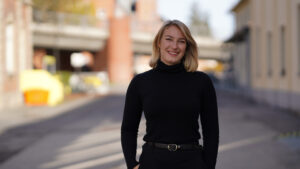
Rebecca Kopf
Describe your idea or project in a few sentences! How did you come up with your business idea? What problem are you solving?
Many organizations rely on theory-heavy training programs for leadership development. However, these rarely lead to lasting change, because organizations are highly complex systems, and development begins with the individual and in practice. While effective approaches already exist, they are often not utilized because their implementation is time-consuming and requires specialized, expensive facilitators. This is exactly where my idea comes in. ALI, an AI-powered app for leaders. It makes a scientifically grounded approach to human resources and organizational development more accessible, more customizable, and more resource-efficient. This enables leaders to learn through hands-on experience and drive real change within their organizations.
How far have you been able to take your idea this year, and where are you at right now?
This year, I’ve not only further developed my idea in theory, but have also worked intensively on a suitable business model. Today, I have a much clearer picture of what ALI is intended to achieve and how it can be implemented in practice. A special milestone is coming up in October, when I’ll have the opportunity to present the theoretical foundation of my idea at the Global Forum of Action Learning in Montreal. It’s a great opportunity to gain further insights and feedback from international experts.
What was your experience like while participating in foundHER?
The program has opened many doors for me—from inspiring workshops and valuable encounters with other founders to defining moments, such as my pitches at Pitch & Beer and the Upper Franconia Innovation Summit. These experiences have not only helped me grow professionally but have also encouraged me to share my idea with confidence. I’m especially grateful to my mentor, who has always been a reliable source of support through both the highs and the lows.
How has your idea—or you yourself—changed over the course of the program?
I’ve learned to break down big and complex ideas to their core first, so I can take action. At the same time, I’ve gained more knowledge about the startup scene and have become more confident in actively approaching people and asking specific questions.
What tips or advice would you like to share with other women who are thinking about starting a business?
Female Founders A good idea is just the beginning, but what really matters is whether it can be implemented. You shouldn’t cling too tightly to the first version, because making adjustments isn’t a step backward—it’s a sign of strength and an understanding of the market. You should start sharing your idea early on, even if it’s not perfect yet, and build a supportive network that empowers you.
Rebecca Kopf was accompanied by Sabrina Hufnagel.
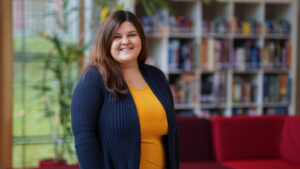
Regina Rumler
Describe your project in a few sentences! How did you come up with your business idea? What problem are you solving?
Bastelfaktur offers creative workshops and DIY experiences that give parents and children a valuable break from the hustle and bustle of everyday life. Under the motto “Homemade instead of store-bought—together instead of alone,” participants create lovingly designed, one-of-a-kind items, ranging from back-to-school goodie bags to seasonal decorations and small gifts. The idea came from my own experience as a mother. I realized how important these creative moments of “quality time” with my children are—moments without cell phones, without the hustle and bustle—but simply spending time together, laughing, and making memories. Many parents want exactly that, but often don’t know where to start. With Bastelfaktur, I want to inspire them to enjoy relaxed, shared creative experiences.
How far have you been able to take your idea this year, and where are you at right now?
Through my participation in the FoundHER program, I was able to significantly develop and professionalize my idea. I clearly defined my target audience and tested my first workshop formats. I’m now part of a pop-up store in downtown Coburg, where I offer workshops: Visitors can purchase a DIY kit or get creative right there on the spot and take their one-of-a-kind, handmade creation home with them right away. I also offer ready-made, one-of-a-kind decorative items. This allows me to combine experience, creativity, and product into a unique concept.
What was your experience like while participating in foundHER?
FoundHER was a huge asset for me—both professionally and personally. I learned how to turn my creative ideas into a viable business model and to bring my vision to life step by step. The coaching sessions, workshops, and discussions with my mentor were especially valuable. Through FoundHER, I also met Diana. Together with her and my colleague Elisabeth, I’m now working as a team on creative projects. The camaraderie and inspiration within the network are simply priceless.
How has your idea—or you yourself—changed over the course of the program?
It all started with just a desire to create a space for crafting together. Through the program, this has evolved into a well-thought-out, versatile concept—featuring workshops, a pop-up store, and DIY products. I’ve learned to approach my creativity from an entrepreneurial perspective, to structure my ideas, and to implement them in a focused way. At the same time, I’ve grown as a founder: I’ve gained more self-confidence and learned that dreams can become reality if you stick with it and seek out support.
What tips or advice would you like to share with other women who are thinking about starting a business?
Have the courage to take your ideas seriously! You don’t have to do everything on your own—take advantage of networks like FoundHER, find mentors, and seek out people who inspire you. Every startup is a process, and doubts are part of it. The important thing is to stay true to your vision and keep moving forward, one step at a time. And above all: Enjoy what you do—because that’s exactly what your customers will sense, too.
Regina Rumler was accompanied by Cindy Maaser.

Diana Steinert
Explain your idea in a few sentences!
I create abstract acrylic paintings as well as handmade jewelry from various materials. You can choose your favorite pieces from my existing collection or have them custom-designed to your liking. If you’d like something even more personal, you can have an NFC chip integrated—this turns the piece of jewelry not only into a one-of-a-kind handmade item, but also into a vessel for emotions and stories.
We plan to open an online store and hold occasional sales at art markets—and perhaps even open a small craft shop.
How did you come up with your business idea? What problem are you solving?
My business idea was born out of my passion. I’ve been actively involved in creative work for five years. Due to the many requests I’ve received from friends and acquaintances, I now want to expand my existing small business and structure my creative work in a way that is not only fulfilling but also rewarding for me.
Through my jewelry and artwork, I offer an alternative to mass production: handmade, one-of-a-kind pieces that convey exclusivity and personality. My clients receive jewelry and artwork that reflect their style—and are therefore as unique as they are.
How far have you been able to take your idea this year, and where are you at right now?
This year, I’ve been trying out new techniques—including the use of NFC chips. Right now, I’m in the process of breaking down my business model into the different categories I offer (ready-to-wear jewelry, custom jewelry, NFC jewelry, abstract art). I’d like to distinguish these areas from one another a bit, and I’m currently in the process of developing names and logos.
Next, I would like to create a website for the “Exclusive Collection,” which features abstract art and custom jewelry, and set up an Etsy shop for my standard jewelry collection.
I’m keeping the NFC jewelry a “secret” for now, since I want to explore it further on my own first and don’t want to go public with it too soon.
What was your experience like while participating in foundHER?
Participating in foundHER has opened up entirely new opportunities for me. For one thing, we scholarship recipients receive a wealth of input and knowledge through the many workshops offered. In addition, each of us has been assigned a mentor who guides us individually through the startup process. The financial support allows me to invest in professional services—such as working with a designer on my company logo, which wouldn’t have been possible before. At the same time, the scholarship gives me the freedom to try new things without taking on a major risk. For me, it’s the ideal opportunity to get started and find out if my idea works.
How has your idea—or you yourself—changed over the course of the program?
At first, I thought I could offer all my services on a single website. However, through the workshops, I realized that a clear separation makes more sense in order to provide each of my target audiences with the right setting and a tailored approach. I’ve gained a lot of new knowledge—in areas I’d barely encountered before or whose importance I hadn’t realized. Plus, since receiving the fellowship, I’ve really been enjoying networking, and I’ve come to appreciate how valuable it is to exchange ideas with others—whether among fellow founders or through everyday encounters.
What tips or advice would you like to share with other women who are thinking about starting a business?
I’m still at the beginning of my journey as a founder and don’t yet know exactly where it will take me. But that’s precisely why I want to encourage other women to take that first step—even if it seems challenging at first. Starting a business means investing a lot of time, energy, and passion. Along the way, I’ve learned that it’s normal to take detours, to fall behind sometimes, to hit roadblocks, or to have doubts. Still, it’s worth sticking with it, because every challenge brings valuable experience. Even small steps forward are important and show that you’re making progress. I notice that I get impatient at times and wish I were already further along. Here, it’s crucial to stay open-minded, hold on to your own idea, keep your goal in sight, and trust that new doors will keep opening as long as you keep moving forward with courage.
Diana Steinert was accompanied by Sadra Küntzel.
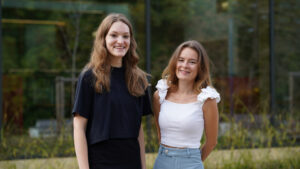
Sofia Wenisch and Anna Weislein
Describe your idea in a few sentences:
Our goal is to develop a modular building system for children ages four to ten. Through this system, we aim to help them develop self-confidence, courage, imagination, and a sense of self-efficacy. With our system, children can independently create small structures, play areas, and imaginary worlds—all without any tools.
How did you come up with your business idea? What problem are you solving?
The idea originally came about as part of a project during our studies. We quickly realized that the topic had really captured our interest. With our product, we’re bridging the gap between furniture and play: Children have the opportunity to be creative, take on responsibility, and create something of their own without the help of adults.
How far have you been able to take your idea this year, and where do you stand right now?
Thanks in large part to the grant, we were able to make significant progress. We have further developed the product, defined our business model, and established a clear brand identity. Our focus is now on the consistent further development of the modular system.
What was your experience like while participating in foundHER?
We’ve learned to think bigger about our idea and not to downplay our own potential. We’ve also realized how important it is to ask questions like, “What might our product look like in the future?” At the same time, we’ve grown closer as a team through the ups and downs of our startup journey. Today, we know exactly where our strengths lie—and when it makes sense to ask for help.
How has your idea—or yourselves—changed over the course of the program?
The idea has outgrown its “infancy”: We’ve decided to focus on it fully and to test and refine it step by step. Personally, we’ve learned to believe in ourselves and our vision—and to present ourselves with greater self-confidence.
What tips or advice would you like to share with other women who are thinking about starting a business?
The path unfolds as you walk. You need a lot of perseverance, but you shouldn’t take things too seriously. It’s important to allow yourself to take breaks when you get stuck—and to believe that, step by step, a path will open up.
Anna Weislein and Sofia Wenisch were accompanied by Kathrin Lang and Nina Wolf.
Overview
The website of Coburg University of Applied Sciences was translated using translation software provided by a third-party provider such as DeepL. The official text is the German version of the website. No liability is assumed, either explicitly or implicitly, for the accuracy, reliability, or correctness of the translations into another language.