

17. June '26
77-Abschied Rossner-2
Prof. Dr.
(Andreas T. Wolf)
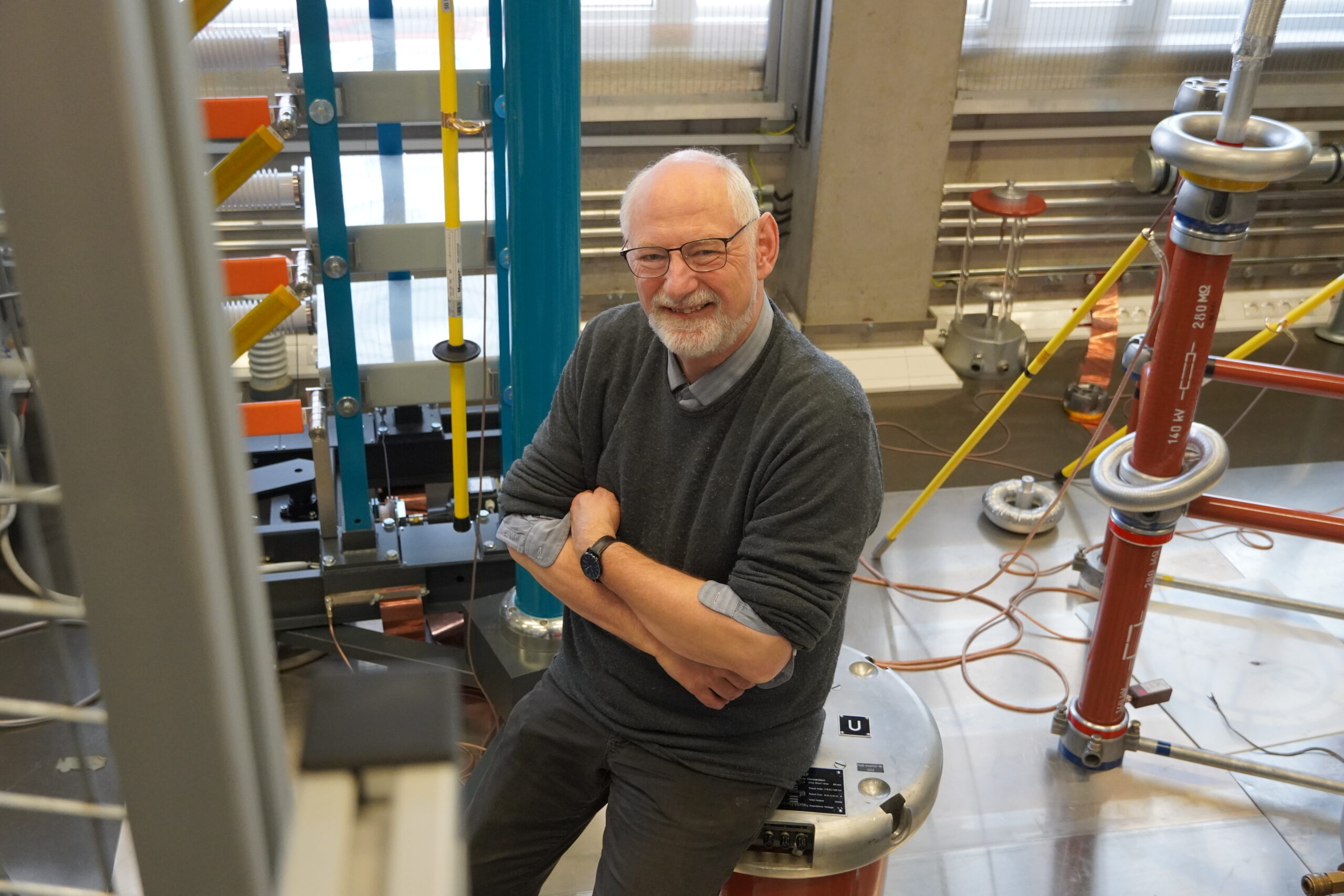
In 1995, many things were still different; even Coburg University of Applied Sciences and Arts was still called a “Fachhochschule” back then. Now, Prof. Dr. Michael Rossner has reached his 62nd—and thus final—semester. In September, the 66-year-old professor of (among other things) high-voltage engineering will retire. In this interview, he looks back on his time at the Department of Electrical Engineering and Computer Science.
What motivated you to become a professor 31 years ago, and why did you choose Coburg?
Prof. Dr. Michael Rossner: I grew up in Karlsruhe, where I once attended a trial lecture at the Karlsruhe University of Applied Sciences. I thought the lecturer was so great back then that I thought to myself, “I want to do something like that, too!” I later earned my doctorate in Hamburg, and at the time, Coburg was one of the few places where I could continue my work in high-voltage engineering.
So you deliberately chose an academic career instead of one in industry?
I need to interact with people; I enjoy explaining things and find it rewarding to share my knowledge. Once you’ve understood something complex, you have to be able to explain it as simply as possible—otherwise, you haven’t really understood it after all.
During your time at the university, the department has also undergone changes. What particularly impressed or surprised you?
Initially, there was the Electrical Engineering program, which was also the name of the faculty in 1995. Then Computer Science was added , and we transitioned to the bachelor’s and master’s degree systems. Electrical Engineering has become increasingly specialized with degree programs in Automation Technology and Robotics, Energy Engineering, and Renewable Energy. We now even offer doctoral programs! We’ve continued to grow, and our faculty alone now offers ten degree programs—some of which are taught in English. At the same time, the importance of applied research has grown significantly across the entire university, and I was particularly pleased to be able to play an active role in addressing the challenges of the energy transition—it’s all been very impressive. But administrative and management responsibilities have also increased significantly.
How has working with students changed for you?
In the past, everything was more like school—that is, “lecture-based instruction.” These days, there’s much more interaction between instructors and students, more project-based, hands-on work, and also the opportunity to conduct research alongside coursework and even pursue a doctorate later on.
Why would you recommend Coburg University of Applied Sciences and Arts’s degree programs to others?
I think our project-based research master’s program in“Electrical Engineering and Information Technology”—which we offer in cooperation with the Technical Universities of Aschaffenburg and Würzburg-Schweinfurt—is simply brilliant as a way to round out one’s studies. We collaborate with these institutions through our joint Doctoral Center, Sustainable and Intelligent Systems (NISys), which allows students to earn their doctorate here as well. In addition, students can flexibly switch between the three electrical engineering degree programs up until the 4th semester. The campus is relatively centrally located, and our internships, along with the facilities in the ZME research building—featuring light-filled rooms and proximity to research projects—are motivating factors.
He is also the director of the Institute for High-Voltage Engineering, Energy Systems, and Plant Diagnostics (IHEA).
The IHEA was founded to create a platform for our research activities, our doctoral students, and our scientific work. It also serves as a virtual meeting place to coordinate activities and act as a point of contact for science and scientific knowledge transfer in the region—something that small and medium-sized industrial companies in particular are seeking. Here, we showcase our expertise and our research and testing capabilities.
You’ll be retiring soon. How will you say goodbye, and what will you remember most?
Of course, I plan to give a wonderful farewell lecture, and I also hope to stay in touch with “my” university through teaching assignments and advising doctoral students. I will remember this as an incredibly rich time filled with wonderful experiences with students, staff, and colleagues—with parties and rock ’n’ roll in the old parking lot, the elaborate construction of a new high-voltage hall, and many late-night sessions spent getting changes and reforms off the ground.
What advice would you definitely want to give to others who are interested in a professorship?
The beauty of our profession lies in the wide range of creative possibilities, which everyone should make the most of according to their strengths. That’s why each of us should figure this out for ourselves. The common thread, however, remains our love and connection to our students, as well as our interest in discovering and shaping new developments in our field.