

20. November '26
178-Bavarian Future Energy Award_Max Stammberger
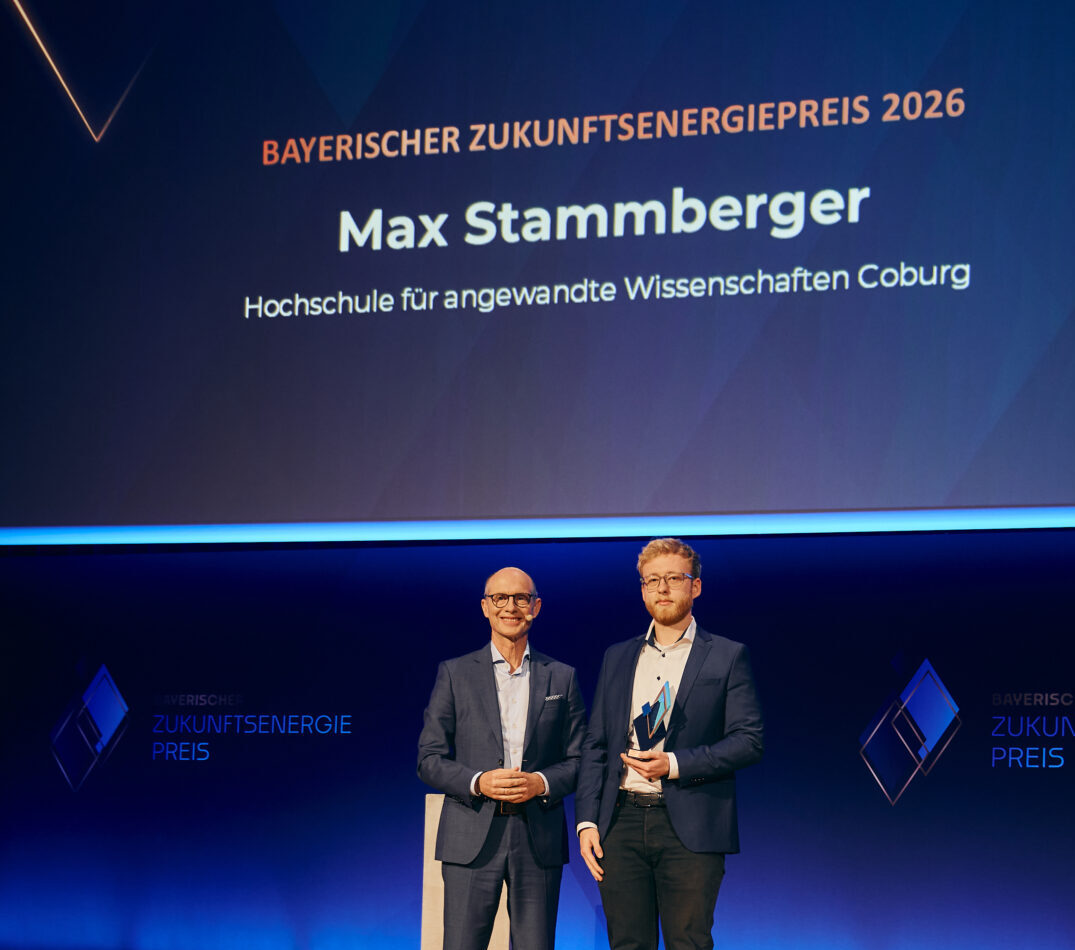
Dr. Egon Leo Westphal, CEO of Bayernwerk AG, presented Max Stammberger with the 2026 Bavarian Future Energy Award. Photo: Andreas Fuchs / Bayernwerk
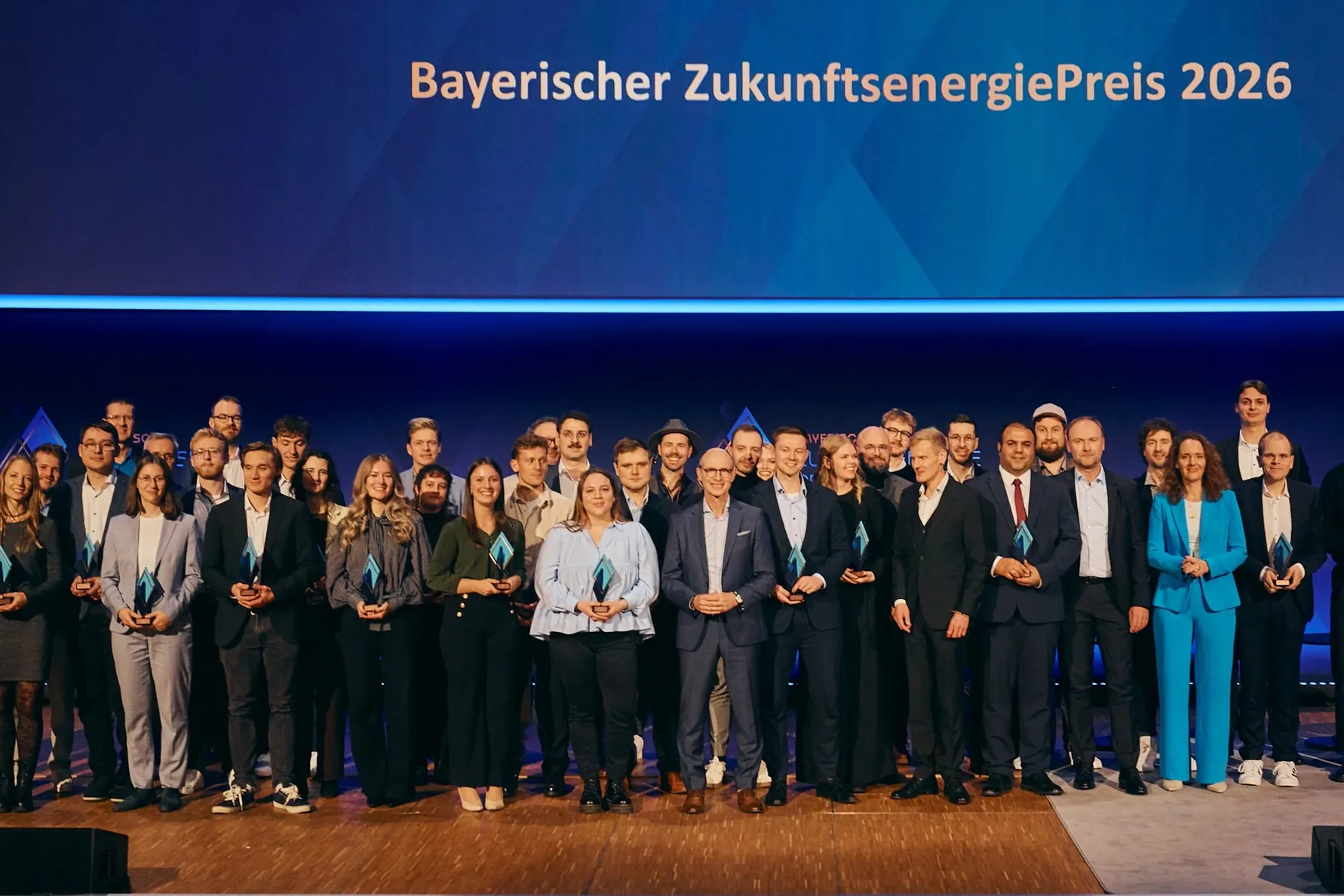
178th Stammberger Bavarian Future Energy Award 2026_Group Photo
Outstanding master's theses and dissertations on the future of energy: Bayernwerk AG has honored 23 graduates from Bavarian colleges and universities with the Bavarian Future Energy Award. Photo: Andreas Fuchs / Bayernwerk
(Andreas T. Wolf)
More solar power, heat pumps, and electric cars are changing the demands placed on our power grids. Max Stammberger developed a computational core at Coburg University of Applied Sciences and Arts that allows for much faster analysis of different operating conditions. The idea originated during his bachelor’s thesis and has now been honored with the Bavarian Future Energy Prize.
Sometimes a research project starts with a roadblock. For Max Stammberger, it was a computer program: For his bachelor’s thesis, he had linked electricity, heating, and gas networks together in a single model. But as soon as he wanted to analyze larger networks or try out new ideas, the calculations became a bottleneck. “I was immediately drawn to the idea of overcoming this obstacle by diving deep into the programming myself,” he says.
A native of Coburg, he first studied energy engineering and renewable energy at Coburg University of Applied Sciences and Arts. He further developed his research topic during his subsequent project-based master’s program in electrical and information engineering. Today, he works at the university as a research assistant.
A modular system for grid calculations
Such models help analyze how different systems interact: When does a heat pump need electricity? How much heat can a storage tank hold? And can consumption times be shifted in a way that reduces the load on the power grid?
Stammberger describes the principle as a modular system. A model of the network is created from individual elements such as pipes, storage tanks, or heat pumps. The program automatically generates the physical network equations. In addition, users can add their own equations, for example, to model the behavior of individual systems. For instance, it is possible to specify that a heat pump turns on as soon as the temperature in the heat storage tank falls below a certain value.
In his master’s thesis, Stammberger developed a new computational core in the C++ programming language. It is designed to evaluate such customizable models more quickly. If one variable changes, the program recalculates only the variables affected by that change. Additional optimizations further reduce the computational load.
From Minutes to Seconds
A simulation of one week in a medium-sized medium-voltage grid demonstrated just how much of a difference this makes: The simulation time alone dropped from about 271 to 2.28 seconds. In this test, the optimized computation core was thus about 119 times faster than the unoptimized initial version. According to Stammberger, other grids examined also showed speedups of a similar magnitude.
Progress came gradually. “Even the first optimization more than halved the computation time, and that’s when I knew my approach was working,” he recalls. It was particularly challenging to familiarize himself with high-performance programming and develop suitable algorithms.
“Mr. Stammberger has developed a simulation tool that combines physical representation, flexibility, and computational speed in a way we haven’t seen before,” says Prof. Dr. Christian Weindl, who supervised the work. “We can use it to run through many scenarios, such as how heat pumps and storage systems can relieve the strain on the power grid. That’s exactly the kind of question grid operators are asking themselves in the context of the energy transition.”
According to Stammberger, the program is already being used in two research projects at the university. His next goal is to make it more accessible: the interface and user experience should help even new users quickly understand how everything works.
Wins the Bavarian Future Energy Award
For his master’s thesis, Stammberger received the Bavarian Future Energy Award from Bayernwerk, which comes with a prize of 3,000 euros. The award was presented on November 19, 2026, at the Science Congress Center Munich—it was the first ceremony in this new format, through which Bayernwerk AG continues its more than 20-year tradition of supporting outstanding scientific theses, which had previously been carried out under the umbrella of the Bavarian Culture Prize.
“The energy of the future is born where a spirit of inquiry, enthusiasm, and the courage to find new solutions come together,” said Dr. Egon Leo Westphal, CEO of Bayernwerk AG and host of the evening, at the awards ceremony.
The award means a lot to him, says Stammberger: It shows that his work is contributing to the future of energy systems and is highly valued.
Video Presentation of the Project
A video feature on award winner Max Stammberger and his work can be viewed here.