

FAQs About Starting College
Here's how to get the big picture!
To help you get your bearings quickly, we’ve compiled answers to key questions about starting college in our FAQ.
Our “Basics for Freshmen” videos give you an overview of how college works, where to find what you need, who can help you with what, and what you can experience and discover during your time here .
You can also look up important terms and abbreviations here .
Questions about studying
Are the courses held online or in person?
Coburg University of Applied Sciences and Arts is a campus-based institution. Therefore, most courses will take place on campus in Coburg, Bamberg, Lichtenfels, or Kronach. In some cases, online courses may supplement in-person study.
Where can I find my class schedule? Do I need to register for courses?
You can find information about your class schedule on your degree program page in the mycampus student portal. You’ll also receive your schedule at the program-specific orientation session. There, everything else will be explained, such as group assignments or registration for individual elective courses, if applicable to your program. You don’t need to do anything before the orientation session.
Can I take additional courses in addition to my regular classes?
Yes. There are foreign language courses, courses on study skills, courses on natural sciences and social issues, as well as courses on art and culture, and a wide variety of sports courses. You can find more information on registration and the current schedule on the student portal mycampus under “University Sports,” “Studium Generale,” and “Languages.” Depending on the program, registration is open until the start of classes or during the first or second week of classes.
Who are my points of contact during my studies?
Questions about your degree program will be answered by the program coordinators. You can find their contact information on your degree program’s page in our student portal, mycampus. On the pages “Academic Organization” and “Advising and Support ,” you ’ll find additional information on who can help you with specific concerns.
Questions About Organizational Matters Related to Your Studies
What is a certificate of enrollment, and how do I get one?
The certificate of enrollment is proof that you are enrolled (Latin: “immatrikuliert”) at Coburg University of Applied Sciences and Arts, which you’ll need, for example, for the child benefit office or your health insurance provider. You can download it from the PRIMUSS portal (under “Certificates”) as soon as you’ve activated your student account.
How do I get my student ID card?
By mail—find all the details here.
How do I add money to my student ID card?
Top-up stations are available for you at the Friedrich Streib Campus (basement of the cafeteria and the cafeteria itself), the Design Campus, and the Lucas Cranach Campus, where you can add credit to your student ID card. You can also set up automatic top-ups from your bank account.
How can I borrow books from the library?
Your student ID also serves as your library card. You can find information about opening hours and how to use the library here and on our student portal, mycampus.
I don’t have a printer or copier at home. Can I print at the university?
Yes. Every campus has multifunction devices for printing, copying, and scanning, and you can send documents to them from your own laptop via Wi-Fi. To retrieve and print documents at the printer, you’ll need your student ID card, as it functions as a prepaid card for printing costs. First, you’ll need to load money onto your ID card and transfer it to your printing account. For more information, visit the IT Service page on our student portal, mycampus.
Is there licensed software I can use while I’m a student?
Yes, licensed software is available to all students at the university at a low cost or for free, such as Office 365. More information is available on the student portal, mycampus.
Questions About Finding Your Way Around Campus
How do I get to Coburg University of Applied Sciences and Arts?
You can find detailed directions here. The semester ticket covers many public transportation options in the region!
What about parking?
There is no student parking on the Design Campus. You can use the public paid parking garages and the Anger parking lot.
The Friedrich Streib Campus has a parking garage with free parking spaces for students (including accessible and parent-child parking spaces). To use it, you must print your parking pass from the PRIMUSS portal (under “Certificates”) and place it behind your windshield (you’ll need to activate your student account first). You can check whether there are any spaces available in the parking garage on our display boards on Thüringer Straße (near the Sonneberger Straße parking lot) and at the intersection of Thüringer Straße and Eisenacher Straße. If the parking garage is full, please use the alternate parking lot on Sonneberger Straße. Or take public transportation with your semester pass!
How do I find a specific room?
All room numbers on the Friedrich Streib Campus follow this format: Building-Level-Room. Example: Room 11-U01 is located on the Friedrich Streib Campus in Building 11, basement (U), room 01. Some rooms, especially the large lecture halls, have a name in addition to their room number. For example, room 11-U01 is also known as the Brose Auditorium. You can find a campus map here.
Room numbers on the Design Campus also follow the “building-level-room” convention. Unlike the rooms on the Friedrich Streib Campus, the buildings on the Design Campus are designated with the letter D. For example: Room D1-009 is located on the Design Campus in Building 1, Level 0, Room 09.
Some rooms, especially the large lecture halls, have a name in addition to their room number. For example, room D1-009 is also known as the Audimax on the Design Campus. You can find a campus map here.
Is there anywhere to eat and drink on campus?
TheFriedrich Streib Campus, the Design Campus, and the Lucas Cranach Campus each have a cafeteria that serves hot meals at lunchtime, including vegetarian and vegan options. The Friedrich Streib Campus also has a cafeteria that sells snacks, coffee, and beverages from morning until late afternoon. It’s also worth stopping by the café-bar in the entrance area of the central library. You can find current opening hours and menus online on the Studierendenwerk Oberfranken website.
Outside of opening hours, vending machines offering hot and cold beverages as well as snacks are available at both the Friedrich-Streib Campus and the Design Campus. You can pay cashless with your student ID at the cafeteria, the snack bar, and the vending machines.
Questions about housing and living in Coburg
I don’t live in Coburg yet. What do I need to know?
You can find information about student housing here. Information on registering your residence with the City of Coburg can be found here.
What can I do in my free time?
Here’s some information about campus life, and here are some ideas for getting to know Coburg.
Where can I travel with the semester ticket?
Here you can find out which routes the semester ticket covers.
Questions about studying
Do the courses take place online or in person?
Most courses will be held on campus in Coburg, Bamberg, Lichtenfels, orKronach. Proven online formats may supplement in-person instruction. You can find more information about the class schedules on the program pages in mycampus.
Where can I find my class schedule? Do I need to register for classes?
First-semester students do not have to put together their own class schedules. You will receive your schedule no later than the program-specific orientation session. This session will also include a detailed explanation of the class schedule.
For some courses within the degree programs, registration is required, especially for so-called “elective-required modules.”
Can I choose additional courses (e.g. language courses) in addition to my normal courses?
Yes. As part of the Studium Generale program, we offer you a wide selection of courses: You can choose from various foreign languages, courses on study skills, topics in the natural sciences and social sciences, and even art and culture. In addition, the Office for Academic Success and Health offers a variety of sports courses for students. For more information on registration and the current schedule, visit the student portal mycampus (university login required) under “University Sports,” “Studium Generale,” and “Languages.”
Is there licensed software that I can use during my studies?
Yes, licensed software is available to all students at the university at a low cost or for free. This includes, for example:
- Office 365
- Corel
- Origin
- SPSS
- and many more.
For more information and an overview of all programs, visit the IT Service page under “Software” on our student portal, mycampus.
I don't have a printer or copier at home. Can I use the equipment at the university?
Yes. Coburg University of Applied Sciences and Arts has printers and copiers on every campus that you can use at any time. You can use these devices to print, copy, and scan. You can also do this from your own laptop or other devices via Wi-Fi. To log in to the printers, all you need is your student ID card, as it serves as a prepaid card for your printing costs. For more information on printing and your printer account, visit the IT Service page on our student portal , mycampus (university login required).
How can I borrow books from the library?
To borrow books from the library, you’ll need your student ID. It also serves as your library card. You can find information on how to borrow books, the library’s hours of operation, and general library use here andon the library’s page on our student portal, mycampus.
Questions about accessibility and orientation on campus
How do I get to Coburg University of Applied Sciences and Arts?
There are various ways to get to Coburg University of Applied Sciences and Arts. You can find detailed directions here.
Where can I park? And where can I get a parking permit?
Campus Design
There is no student parking available at Campus Design. You can use the public parking garages and the Anger parking lot. There is a fee for these.
Friedrich Streib Campus
The Friedrich Streib Campus has a parking garage with 530 spaces for students and staff. Accessible parking spaces are available for students with disabilities. Parents with young children may park in the designated parent-child parking spaces.
Parking Permit
To park here, you must prove that you are a student at the university. There is a parking permit for this purpose, which you must always place in a clearly visible spot on your car’s windshield. You can find it in the PRIMUSS portal under “Certificates” once your student user account has been activated.
Is the parking garage full?
You can check whether there are any spaces available in the parking garage on our information boards on Thüringer Straße (near the Sonneberger Straße parking lot) and at the intersection of Thüringer Straße and Eisenacher Straße. If the parking garage is full, please use the alternate parking lot on Sonneberger Straße.
We also recommend the following alternatives:
- Semester Pass
Your student ID also serves as your semester pass. With it, you can ride many public transportation routes in Coburg for free. The semester pass is valid only on the designated routes. - Carpooling
Form carpools with your fellow students to get to the university.
How do I find my way around the campus?
Campus maps and room layouts are available for both the Friedrich Streib Campus and the Design Campus. You can find them here.
How do I find a specific room?
Friedrich Streib Campus:
All room numbers on the Friedrich Streib Campus are generally structured according to the following principle: building-level-room.
Example: Room 11-U01 on the Friedrich Streib Campus is located in Building 11, basement (U), room 01.
Some rooms, especially the large lecture halls, have a name in addition to their room number. For example, room 11-U01 is also known as the Brose Auditorium.
You can find a map of the buildings on the Friedrich-Streib Campus here.
Campus Design:
All room numbers on the Design Campus are generally structured according to the following principle: building-floor-room. Unlike the rooms on the Friedrich Streib Campus, the buildings on the Design Campus are designated with the letter D.
Example: Room D1-009 is located on the Design Campus in Building 1, Level 0, Room 09.
Some rooms, especially the large lecture halls, have a name in addition to their room number. For example, room D1-009 is also known as the Audimax on the Design Campus.
You can find a campus map and a floor plan of the Design Campus here.
Is there anything to eat and drink on campus?
There is a cafeteria at the Friedrich Streib Campus, the Design Campus, and the Lucas Cranach Campus that serves hot meals at lunchtime. You’ll also find vegetarian and vegan options here. The Friedrich Streib Campus also has a cafeteria that sells snacks, coffee, and beverages from morning until late afternoon. It’s also worth stopping by the café-bar in the entrance area of the central library. You can find the current opening hours and menus online on the Studierendenwerk Oberfranken website .
Outside of opening hours, vending machines offering hot and cold beverages as well as snacks are available both at the Friedrich-Streib Campus and the Design Campus. You can conveniently pay cashless with your student ID card in the dining hall, the cafeteria, and at the vending machines. Click here to learn how to load money onto your student ID card.
Questions about the organization
How do I get my student ID?
As a first-semester student, you will receive your student ID card by mail from our Office of Academic Affairs. It will be sent to the address you provided in your application. Please let us know about any address changes as soon as possible. You can easily do this online once your student account has been activated in the PRIMUSS portal. You can find more information about the student ID card and its features here.
How do I load money onto my student card?
At the Friedrich Streib Campus, the Design Campus, and the Lucas Cranach Campus, there are reload stations where you can easily add credit to your student ID card. You can also set up automatic reloads from your bank account.
What is a certificate of enrollment and how do I get one?
The Certificate of Enrollment is proof that you are enrolled (Latin: “immatrikuliert”) at Coburg University of Applied Sciences and Arts. You’ll need it, for example, to provide proof to the child benefit office or your health insurance provider. You can print it out yourself as soon as you’ve activated your student account with us. Log in to the PRIMUSS portal using your login credentials (username and password). There, under the “Certificates” section, you’ll find the certificate of enrollment.
Who are my contact persons during my studies?
If you have questions or problems regarding the organization of your studies:
There are various student service centers at Coburg University of Applied Sciences and Arts. Especially at the beginning, you’ll need:
- Student Affairs Office
—responsible for applications, enrollment, student ID cards, and certificates - Academic Advising
assists with all questions regarding your studies - IT Services
is the point of contact for technical questions (access to university servers, access to the Wi-Fi network, setting up an email account, etc.)
On the “Academic Organization” and “Advising and Support” pages, you’ll find further information on who can help you with specific issues.
For questions and issues specific to your degree program:
You can find the contact persons for your degree program on the program pages for your major on our student portal, mycampus. You can also contact your program’s student council at any time.
Questions about housing and living in Coburg
Where can I find information about the city of Coburg?
Information on the city of Coburg, e.g. on housing registration, housing benefit or new residents’ get-togethers can be found here.
How can I find an apartment?
You can find information and support on finding accommodation in Coburg and the surrounding area on our page Accommodation in Coburg.
What leisure activities are there in Coburg?
We’ve put together a list of the various recreational activities for you on the ” Recreation in Coburg ” page.
Are there any student-led initiatives at Coburg University of Applied Sciences and Arts? How can I get involved?
Whether you’re interested in politics, have a talent for singing, are socially engaged, or enjoy crafts and tinkering—there’s definitely a place for you in one of our student organizations. You can find an overview of the university’s student organizations here.
What discounts are available for buses and trains?
The semester fee includes the semester ticket, which is valid for certain modes of transportation in Coburg and the surrounding area. As a student at a Bavarian university, you can also purchase a discounted Deutschland-Ticket. For more information, contact the Studierendenwerk Oberfranken and the VGN.
Questions about our campuses
Coburg: Campus Friedrich Streib
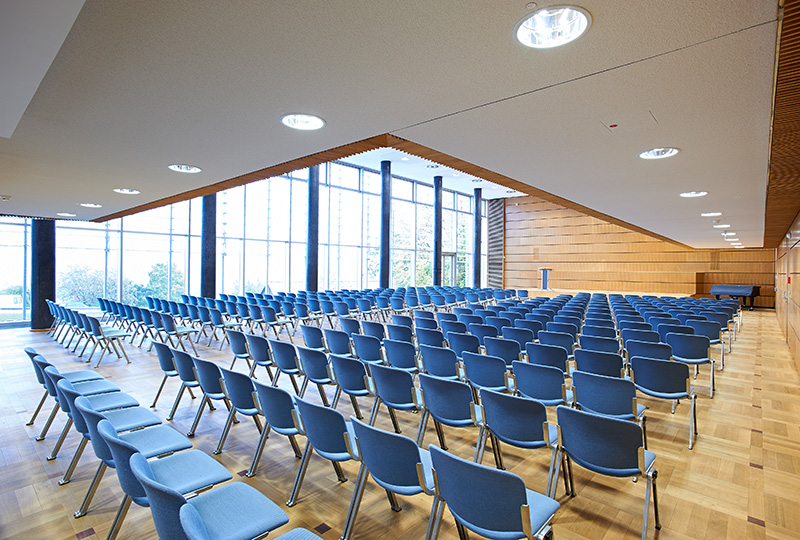
The Friedrich Streib Campus is located on the Judenberg, in the western part of Coburg. From here, there is a stunning view of the historic old town and the Veste Coburg across the way.
Three-quarters of the students study on campus, in the fields of natural sciences and engineering, social work and health, and business. The university leadership and central administration are also based here.
The first buildings on the Friedrich Streib Campus were inaugurated and occupied on May 20, 1960—by a predecessor institution of the university, the State School of Architecture. The first student residence hall was built as early as 1961.
Over the following decades, a modern university campus developed here, featuring lecture halls, seminar rooms, offices, laboratories, and workshops. The campus currently comprises five student residence halls with a total of 506 rooms and apartments.
The Friedrich Streib Campus will continue to expand in the coming years. A parking garage, a laboratory building—the Center for Mobility and Energy—and the IT and Media Center have already been completed.
Address
Coburg University of Applied Sciences
Friedrich-Streib-Straße 2
96450 Coburg
Coburg: Campus Design
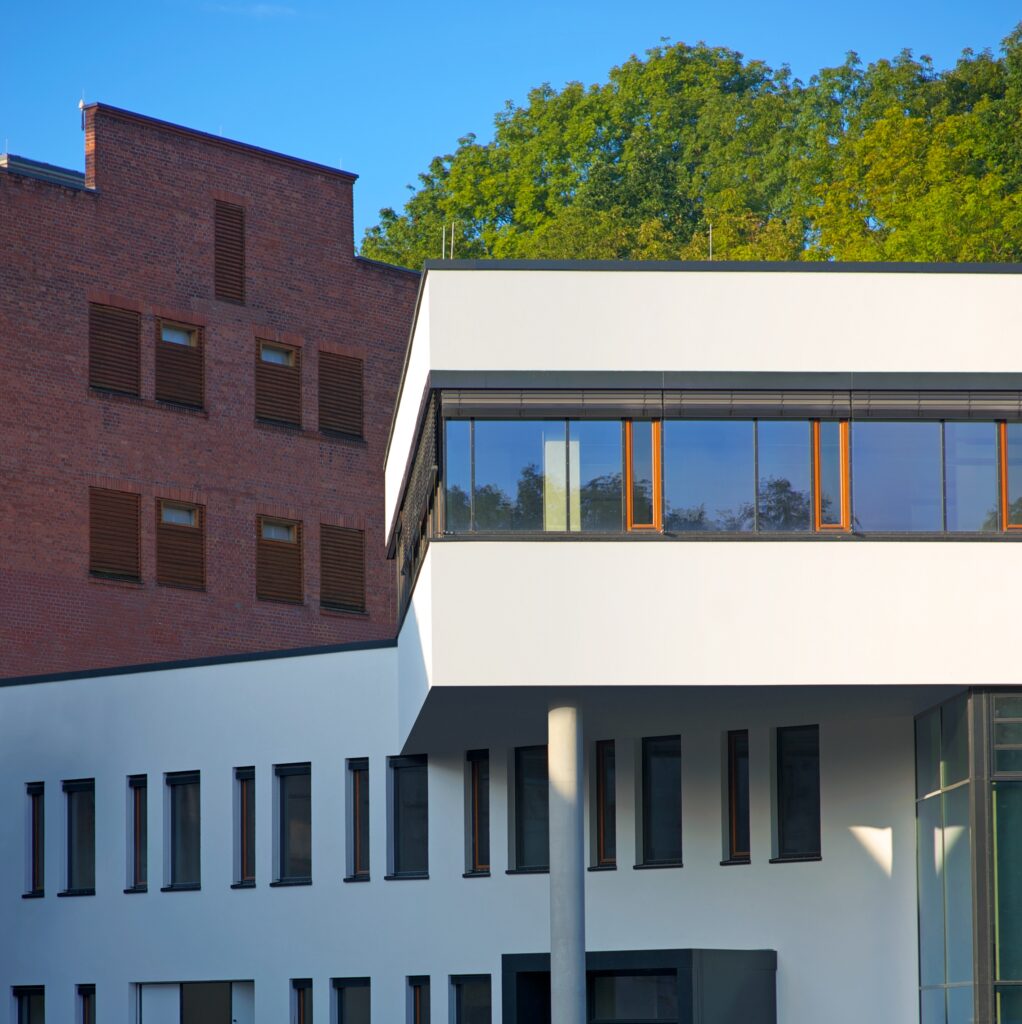
The Coburg Design Campus is home to the School of Design, with its bachelor’s and master’s students in the fields of architecture, civil engineering, interior design, and product design. The historic “Herzogliche Hofbrauhaus,” located on the outskirts of downtown Coburg, forms the heart of the campus. Following a complete renovation, the Interior Architecture and Integrated Product Design programs moved here during the 1999–2000 winter semester. In 2012, new buildings for teaching and research, as well as a branch library and a cafeteria, were added. The Institute for Sensor and Actuator Technology (ISAT) is also headquartered here. The campus also features a student residence with 106 apartments.
Address
Am Hofbräuhaus 1
96450 Coburg
Lichtenfels: FADZ

Some of the students on the Additive Manufacturing and Lightweight Design Master’s degree course complete their studies at the Research and Application Center for Digital Future Technologies (FADZ) in Lichtenfels. The premises are currently located at Laurenzistraße 2 – in the heart of the city center. A move to the renovated premises of the former Kirschbaummühle is planned for the future.
The premises at Laurenzistraße 2 offer 3D printing laboratories for metal and plastic, equipment and areas for 3D scanning and laser cutting, a metal and wood workshop, a seminar room and flexible workstations. The process chain of additive manufacturing, from data preparation to the printing process to post-processing, is mapped with the equipment and the premises.
Lichtenfels is not only a basket-making town, but also the cradle of metal 3D printing. The region around Lichtenfels is characterized by numerous cultural highlights. The town lies at the foot of the Staffelberg and is framed by the Banz and Vierzehnheiligen monasteries. Because of its scenic beauty, this area is also known as the “Garden of God”. Students here benefit from a high quality of life and affordable living space.
Address
Coburg University of Applied Sciences – FADZ Lichtenfels
Laurenzistr. 2
96215 Lichtenfels
Kronach: Lucas Cranach Campus
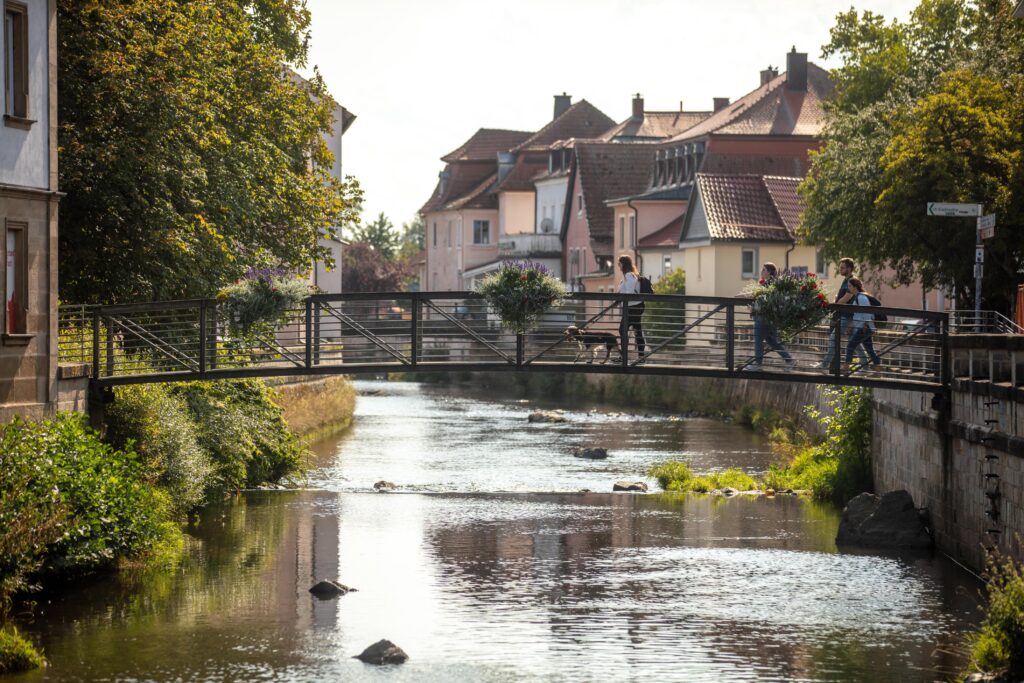
The master’s programs in Future Design and Autonomous Driving, as well as the bachelor’s program in Applied Digital Transformation, are based at the Lucas Cranach Campus in Kronach. Here, the Kronach district has created a modern campus that is open to several universities. Programs offered by Hof University of Applied Sciences are also located here.
The Lucas Cranach Campus LCC is located in the heart of the city of Kronach. New teaching and work rooms, laboratories, a maker space, an indoor test track for autonomous driving and co-working spaces have been set up here. In short, everything that makes up modern studying today. The student infrastructure is also taken care of. Because everything is within walking distance from here: A beer garden, ice cream parlor and cinema are just a two-minute walk away. And the Franconian Forest is ideal for mountain biking and hiking, cross-country skiing or camping.
The campus is named after Lucas Cranach the Elder. He was a serial entrepreneur—a Renaissance-era Elon Musk, so to speak—and worked as a painter, pharmacist, paper merchant, publisher, paint manufacturer, and mayor of Lutherstadt Wittenberg. In his Cranach workshop, he and his team produced countless paintings using prefabricated stencils and an advanced division of labor. The Cranach workshop was thus—if you will—an early precursor to the coworking and maker spaces found at the LCC. Further information can be found on the Lucas Cranach Campus website.
Address
Coburg University of Applied Sciences – Lucas-Cranach-Campus
Güterstraße 8
96317 Kronach
Bamberg: Bamberg Academies
The Bachelor’s program in Midwifery at the Coburg University of Applied Sciences and Arts is taught at the Bamberg campus, at the Bamberg Academies. The campus is located very close to the Klinikum am Bruderwald hospital and is also very well connected by public transportation to Bamberg’s beautiful Old Town.
Address
Bamberg Academies for Health and Nursing Professions
Buger Straße 80
96049 Bamberg
"Basics for Freshmen": Get the lowdown
In our videos, we explain what you need to know about your degree program, who can help you, and how to make your studies a success!
You are currently viewing a placeholder content from YouTube. To access the actual content, click the button below. Please note that doing so will share data with third-party providers.
More InformationYou are currently viewing a placeholder content from YouTube. To access the actual content, click the button below. Please note that doing so will share data with third-party providers.
More InformationYou are currently viewing a placeholder content from YouTube. To access the actual content, click the button below. Please note that doing so will share data with third-party providers.
More InformationYou are currently viewing a placeholder content from YouTube. To access the actual content, click the button below. Please note that doing so will share data with third-party providers.
More InformationYou are currently viewing a placeholder content from YouTube. To access the actual content, click the button below. Please note that doing so will share data with third-party providers.
More InformationClick here to check it out
Click here to check it out
:
Of course, you can also read up on everything you need to know: about how the program is organized, counseling and support services, or campus life.
Terms Related to College
Get familiar with terms related to college!
ECTS
Each module in the degree program is assigned a certain number of ECTS credits. You earn these credits (also known as credit points or performance points) when you pass the exam. The number of credits a module is worth depends on the amount of time required to complete it successfully. Each semester, students in full-time degree programs earn 30 ECTS credits if they pass all the exams specified in the standard curriculum. ECTS stands for European Credit Transfer and Accumulation System and is used throughout Europe.
Student Council and Student Parliament
The term “Fachschaft” refers to the student council (SV) within a faculty. The Student Parliament brings together student representatives from across the entire university. Both the Fachschaft and the Student Parliament are directly elected by students in university elections.
Faculty
A faculty brings together several degree programs and research institutions in a specific field of study. Coburg University of Applied Sciences and Arts has seven faculties.
Five-Point Lead
Anyone who simply lets the deadlines for taking exams pass will receive what is known as a “deadline five,” and the exam will be considered failed. A deadline may result either from a previous failure to pass an exam (retake deadline) or be specified in the Study and Examination Regulations (SPO) for a degree program. After the standard period of study plus two semesters, a “deadline five” also applies to all outstanding exams—this is stipulated in the General Examination Regulations (APO) of Coburg University of Applied Sciences and Arts and applies to all degree programs.
Fellow students and faculty members
The term “fellow students” refers to the other students enrolled at the university. “Faculty” is a collective term for all instructors at universities.
Mentors / Mentoring
Unlike a tutor, who is responsible for specific subject matter, a mentor is someone who serves as a personal point of contact, offering support and drawing on his or her own experiences to help you.
Module
A degree program is divided into several modules, each of which consists of coordinated courses (lectures, exercises, lab sessions, seminars) that cover a specific subject area. A distinction is made between Required Modules, which must be documented in any case, and Elective Modules, in which you can choose from a list of predefined options. In addition, there are also Elective Modules. Here, the selection is very flexible, and you can often even choose courses from other disciplines. Modules are generally graded and assigned a fixed number of ECTS credits. A description of the modules in a degree program can be found in the respective Module handbook, which can also be found online on the program pages.
Standard Duration of Study
The standard period of study specifies the ideal timeframe within which students should complete their degree. It is set for each individual degree program and is generally seven semesters for bachelor’s programs at Coburg University of Applied Sciences and Arts. (Exceptions: Architecture and Interior Design, which are eight semesters.) The duration of BAföG funding is usually tied to the standard period of study.
Feedback
Required at the end of a semester to remain enrolled for the following semester. This is accomplished by paying the semester fee.
Semester (academic, specialized, practical, or leave of absence semester)
The program is organized into semesters (= half a year). The Winter semester runs at Bavarian universities from October 1 to March 14, and the Summer semester From March 15 to September 30
As Academic semester refers to all semesters during which a student is enrolled at a German university, regardless of the degree program. This means that even after changing majors or universities, the number of university semesters continues to increase. In contrast, Academic Semester the semesters during which students are enrolled in a particular degree program. If a student changes degree programs, the number of academic semesters starts at zero. Some universities also use the term Semester of Study or Exams. They are based on the student’s academic performance as defined in the respective study and examination regulations. In the case of a Semester Off Student status is maintained, but exam requirements are suspended. Leave of absence semesters are granted, for example, in cases of illness, parental leave, or caring for family members. The leave of absence semester must be requested through the portal by the deadline PRIMUSS can be requested. Questions about the leave of absence semester can be directed to the Department of Student Affairs at the university. You’ll spend the internship semester at a company or institution, where you’ll gain practical experience on a full-time basis.
Tuition
The semester fee consists of the Student Services fee and the cost of the semester ticket.
Study and examination regulations
Here you will find guidelines and rules regarding the structure of the program, its content, and its objectives. In addition, deadlines for taking exams for the first time and eligibility requirements for advancing to the next level may be specified. Students should be familiar with their respective program guidelines.
SWS
SWS stands for “Semester-Week-Hours.” One SWS lasts 45 minutes—the same length as a school period. If a course has two SWS per semester, that means you attend that course for 1.5 hours per week.
Tutors / Tutorial
A tutorial is always a voluntary session led not by a professor, but by a student from a higher semester, known as a tutor. In a tutorial, the content of a lecture is discussed and practiced. At Coburg University of Applied Sciences and Arts, there are subject-specific tutorials (tutorials for specific required courses in the respective degree programs).
Eligibility for Promotion
In many degree programs, students may advance to a higher semester only if they have successfully completed certain modules. Please refer to the respective academic and examination regulations for details.