


Automation technology and robotics
At a glance
Academic degree
Bachelor of Engineering (B.Eng.)
Form of study
Full-time
Standard period of study
7 semesters (incl. practical semester), 210 ECTS
Place of study
Language of instruction
German
Start of studies
Winter semester (October 01)
Orientation semester also in the summer semester (March 15)
Admission requirements
University entrance qualification, entrance qualification for universities of applied sciences, vocational qualification or foreign educational certificate, no admission restrictions (NC)
Costs
Semester fee (incl. semester ticket)
Orientation semester
Individual modules can be taken as part of an orientation semester
Semester abroad
Possible as a theoretical or practical semester
Studying with a practice partner
Accreditation
accredited by the Accreditation Council
Registration
from May 02 – September 30
Profile of the degree program
The automation of their production processes is an important competitive factor for all branches of industry in Germany. The degree course takes the ongoing trend towards automation, robotization and digitalization of the economy and society very much into account.
Practice-oriented and future-oriented studies.
The regional economy in particular has a high demand for graduates of this course. Electrical engineers with in-depth knowledge of automation technology and robotics make a significant contribution to constantly improving the quality and efficiency of production. They are therefore more in demand than ever.
What we value
Practical relevance
The Bachelor’s degree course in Automation Technology and Robotics at Coburg University of Applied Sciences and Arts is strongly practice-oriented and specifically geared towards the requirements of professional practice. Concrete projects with partners from industry challenge students to present the results of their work with confidence and create contacts with the real world.
Work in small groups
Students work in teams with students from other degree programs and thus train their social skills. Working in small groups also offers intensive and individual support.
Study internationally
Coburg University of Applied Sciences offers the opportunity to complete a study or practical semester abroad. To this end, Coburg University of Applied Sciences maintains relationships with foreign partner universities. Further information is available from the university’s Study Abroad service.
Course content and schedule
First to fourth semester (foundation course)
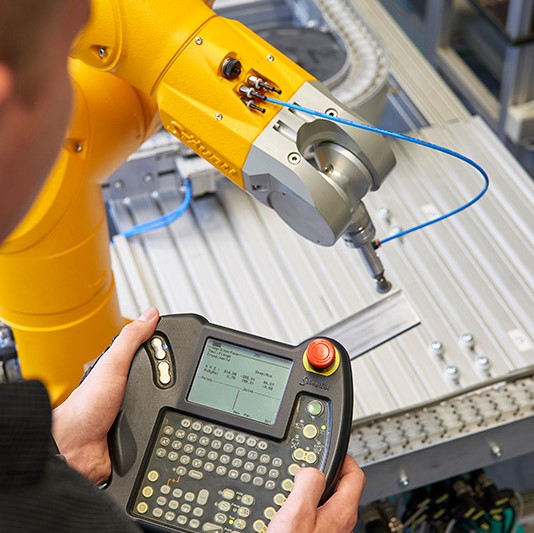
The following basics are taught in the 1st to 3rd semester:
- Introduction to new technologies and sustainability through a thematic lecture series and in-depth laboratory practice
- Fundamentals of mathematics and computer science
- Fundamentals of electrical engineering, in particular: Direct and alternating current technology, electrical and magnetic fields, electronic components and circuit technology, electrical measurement technology, signals, systems, digital and microcomputer technology, electrical drives and networks, automation technology I
4th semester: Practical semester of 20 weeks, of which 18 weeks are spent in a company of your choice and two weeks at Coburg University of Applied Sciences and Arts in the form of practical classes including a practical seminar.
Fifth to seventh semester (specialization studies)
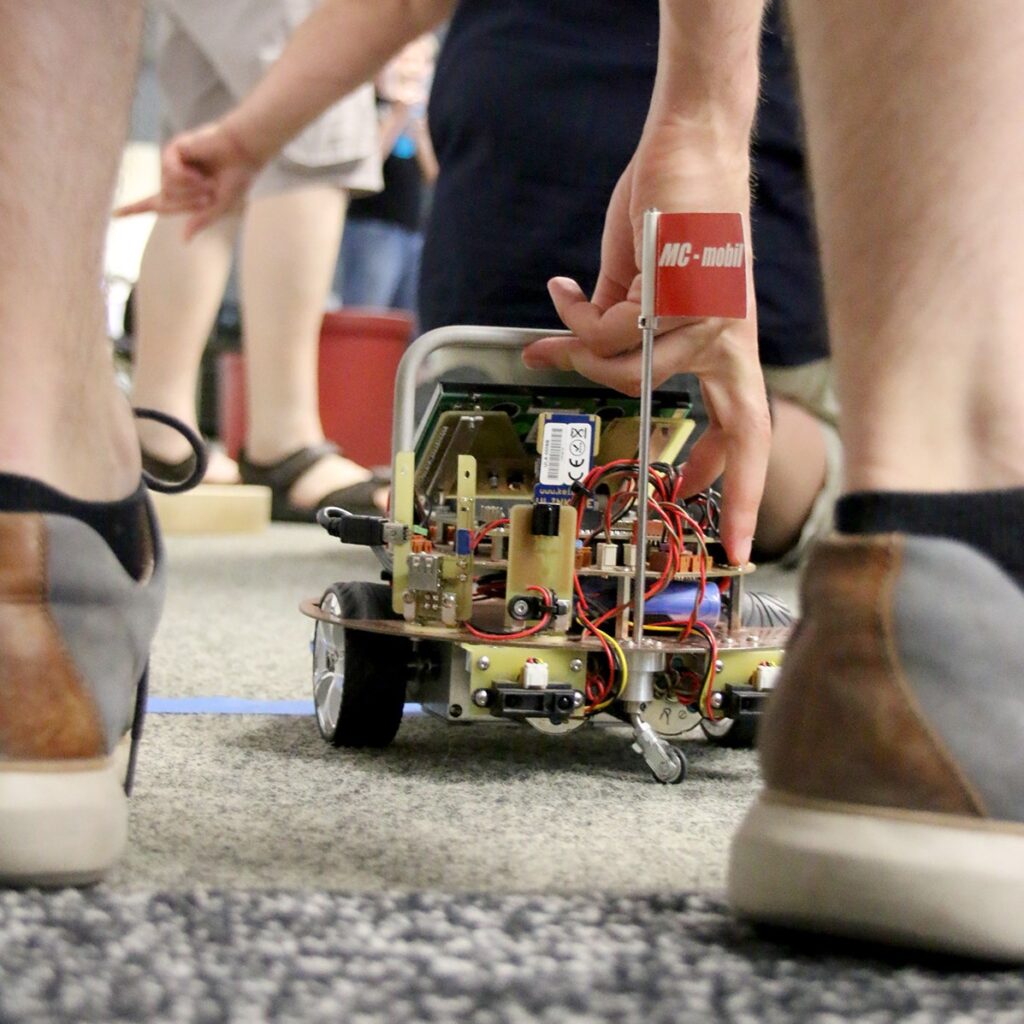
Compulsory subjects:
- Automation technology II
- Software design in automation technology
- Technical English
- Electrical drive and converter technology
- Computer measurement technology
- Robotics
- Motion Control
- Control engineering
- Industrial image processing
- Interdisciplinary key qualifications
- Engineering project
Five application-oriented specialization subjects with elective options:
- Simulation techniques with MathLab/Simulink
- Design of mechatronic systems
- Control technology and industrial bus systems
- Technology of CNC-controlled machine tools
- Robot programming
- Practical control engineering
Specialization subjects offered in other faculties, such as sensor and actuator technology or production engineering, can also be taken.
7th semester: Bachelor’s thesis with accompanying seminar and project management methods.
Orientation semester
Practical semester
“Automation technology and robotics” sounds exciting, but is it (still) too early to really start studying?
Take advantage of our orientation semester!
Your advantages:
-
Individual timetable with modules from one or more degree programs
- Insights into content and working methods
-
Examinations possible – collect first academic achievements
-
Start your regular studies with a head start
In the winter semester, you can take the following courses (modules) in automation technology and robotics:
- Computer engineering
- Laboratory practice
- Programming 1 Electrical engineering
- Lecture series – New technologies and sustainability
You can find more information about the orientation semester here.
Practice during studies
Basic internship
A basic internship is not required. However, we recommend that you do some practical work in relevant companies before starting your studies so that you can get an idea of your future professional practice in good time.
Practical semester
The practical semester is usually in the fourth semester. It is systematically supervised and covers a continuous period of 18 weeks. In addition, there are several practical courses. The practical semester can also be completed abroad. The university has good contacts with companies and helps students to find a suitable internship.
PraxisPLUS
Studying with in-depth practical experience in the PraxisPLUS model offers you the opportunity to gain more practical experience during your studies – without extending the duration of your studies. The prerequisite is a work contract with a company/institution. You can apply your knowledge from the lecture directly at work. The work in the company is remunerated. This in turn makes it easier to finance your studies.
Job & Career
As an export nation in plant and mechanical engineering and automotive production, Germany has a high demand for specialists in the field of robotics and automation. A large number of employees work in the field of electrical automation technology, e.g. in the manufacture of control and switching devices or in image processing. Automation specialists are just as important for manufacturers of production facilities, in automotive production and for specialists in mechanical engineering, such as machine tool manufacturers. In the next few years, far more engineers will be leaving the profession than are currently being trained. The degree course aims to help close this gap.
Do another master's degree!
After successfully completing their Bachelor’s degree, good graduates have the opportunity to gain further qualifications with a Master’s degree. The Master’s course follows on directly from the Bachelor’s course. Coburg University of Applied Sciences and Arts offers several Master’s degree programs for this purpose: Here for an overview. Coburg University of Applied Sciences and Arts offers an interesting model with the so-called Project Master: Master’s students work for three semesters on a scientifically demanding project, which can be based either at the university or with an industrial partner. The students are continuously supervised by a professor while working on the project.
Curriculum and examination regulations
The study plan provides an overview of the structure of the degree program. The module handbook provides information on the content of the individual modules. The study and examination regulations form the legal basis of the degree program. Questions about the content of the course will be answered by the course advisor Prof. Dr. Matthäus Brela.
Student ambassador
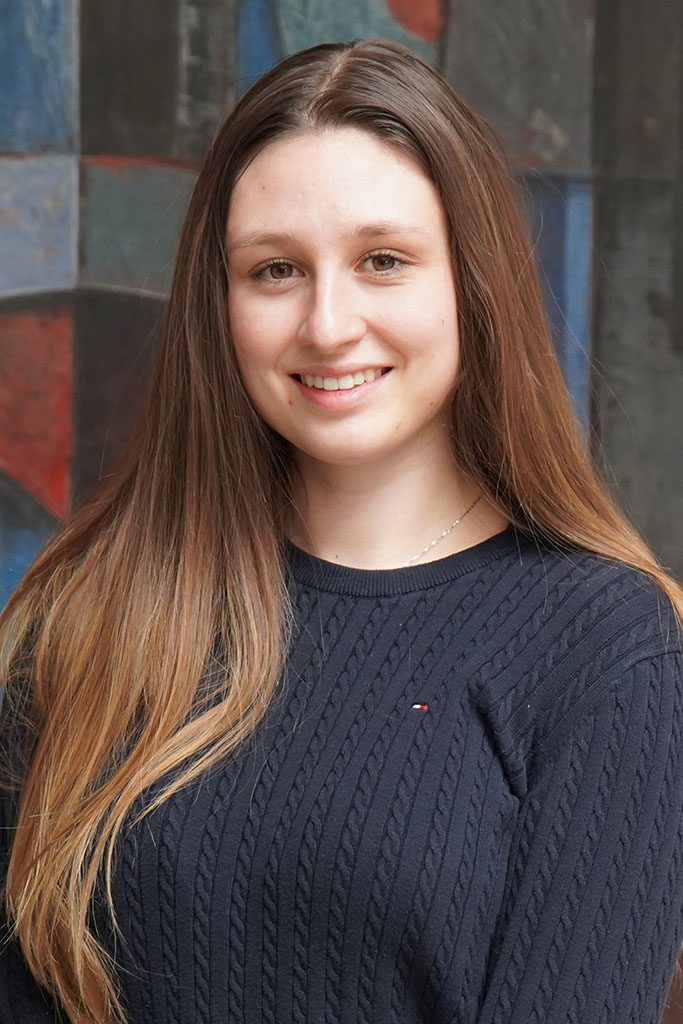
Hello, I’m Vanessa Bier and I’m a student ambassador for the electrical engineering degree programs. As I’m studying an electrical engineering course at Coburg University of Applied Sciences and Arts, I can answer your questions directly. So if you want to know what the degree program is all about or what it’s like to live in Coburg, just send me an email: Vanessa.Bier@stud.hs-coburg.de